Jannis Halbey

I am a fourth-year PhD candidate at the Institure of Mathematics, TU Berlin under the supervision of Sebastian Pokutta. I am also a member of the IOL group at Zuse Institute Berlin and the Berlin Mathematical School (BMS).
My research interests lie in large-scale optimization, convex geometry, and combinatorial optimization, with a particular focus on projection-free methods such as Frank–Wolfe algorithms and their variants. I am interested in the development and analysis of scalable algorithms for convex, constrained optimization, especially correction and active-set strategies. More recently, I have worked on lower bounds and convergence analysis for first-order methods, aiming to better understand fundamental limits of these algorithms. Furthermore, I am actively contributing to the FrankWolfe.jl package.
news
| Oct 01, 2026 | Supervising again the seminar on Modern topics in machine learnign and optimization by Sebastian Pokutta at TU Berlin. |
|---|---|
| Sep 25, 2026 | Our paper Curvature-Dependent Lower Bounds for Frank-Wolfe got accepted at NeurIPS 2026 and I was recongnized as a “Top-Reviewer” of the conference (top 8%). |
| Sep 24, 2026 | Gave a talk on “Curvature-Dependent Lower Bounds for Frank-Wolfe” at GHOST Inria in Grenoble. |
| May 01, 2026 | Our paper Lower Bounds for Frank-Wolfe on Strongly Convex Sets got accepted at ICML 2026. |
| Apr 03, 2026 | Supervising the seminar on Modern topics in machine learnign and optimization by Sebastian Pokutta at TU Berlin. |
selected publications
-
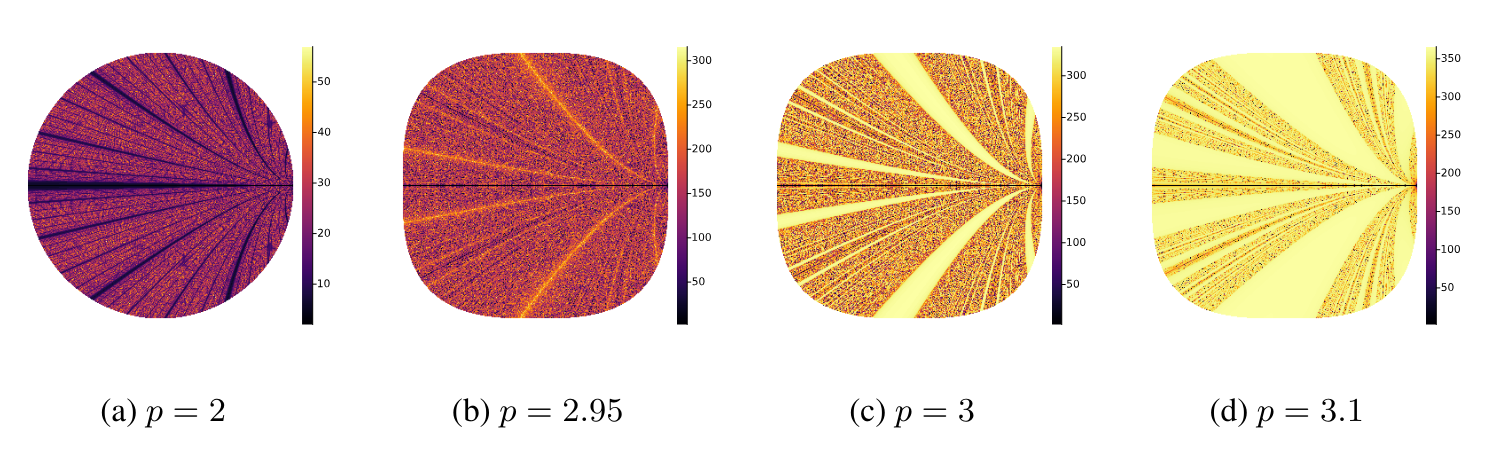 Curvature-Dependent Lower Bounds for Frank-WolfearXiv preprint arXiv:2605.10595, 2026
-
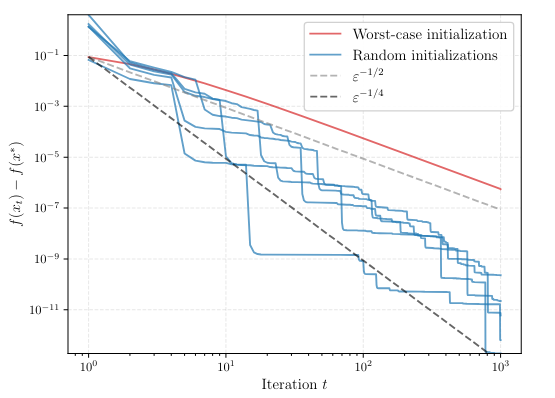 Lower Bounds for Frank-Wolfe on Strongly Convex SetsarXiv preprint arXiv:2602.04378, 2026
-
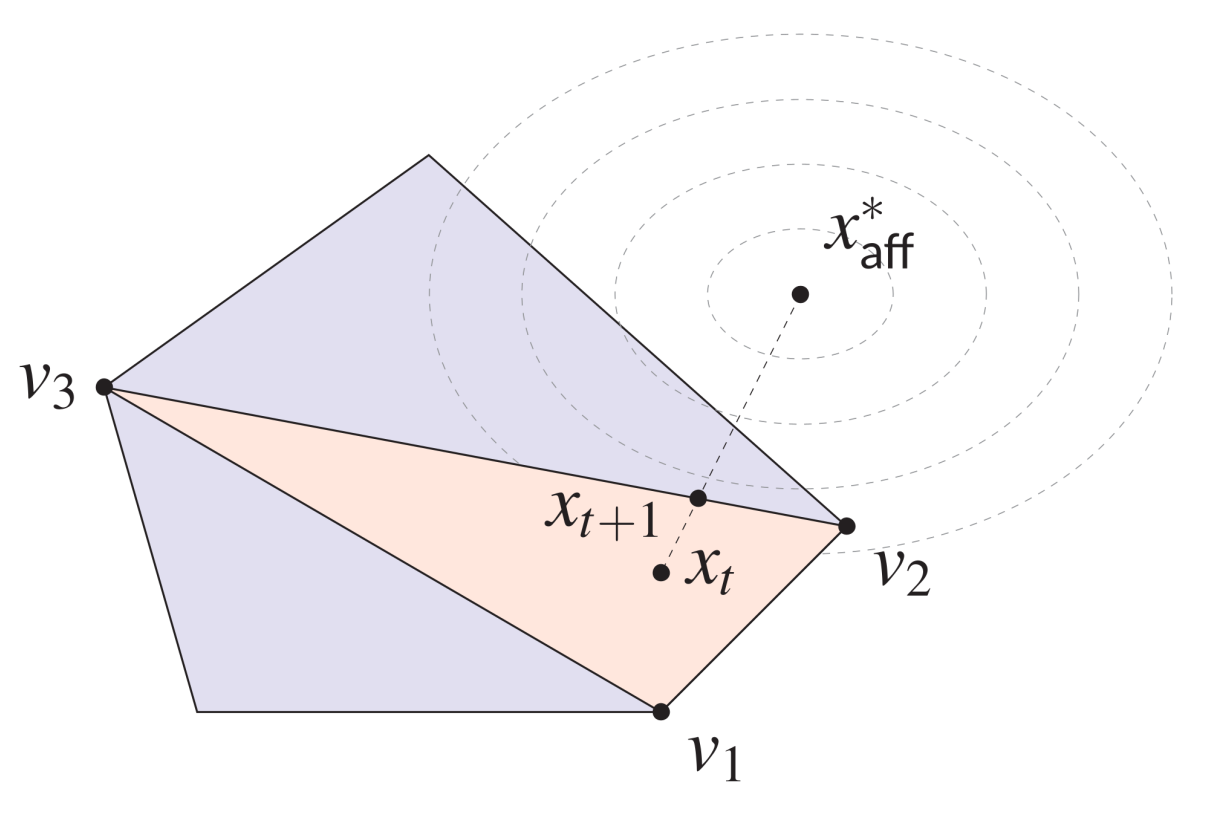 Efficient quadratic corrections for Frank-Wolfe algorithmsAdvances in Neural Information Processing Systems, 2026